Can Paying People to Read Help Revive the Reading Habit?

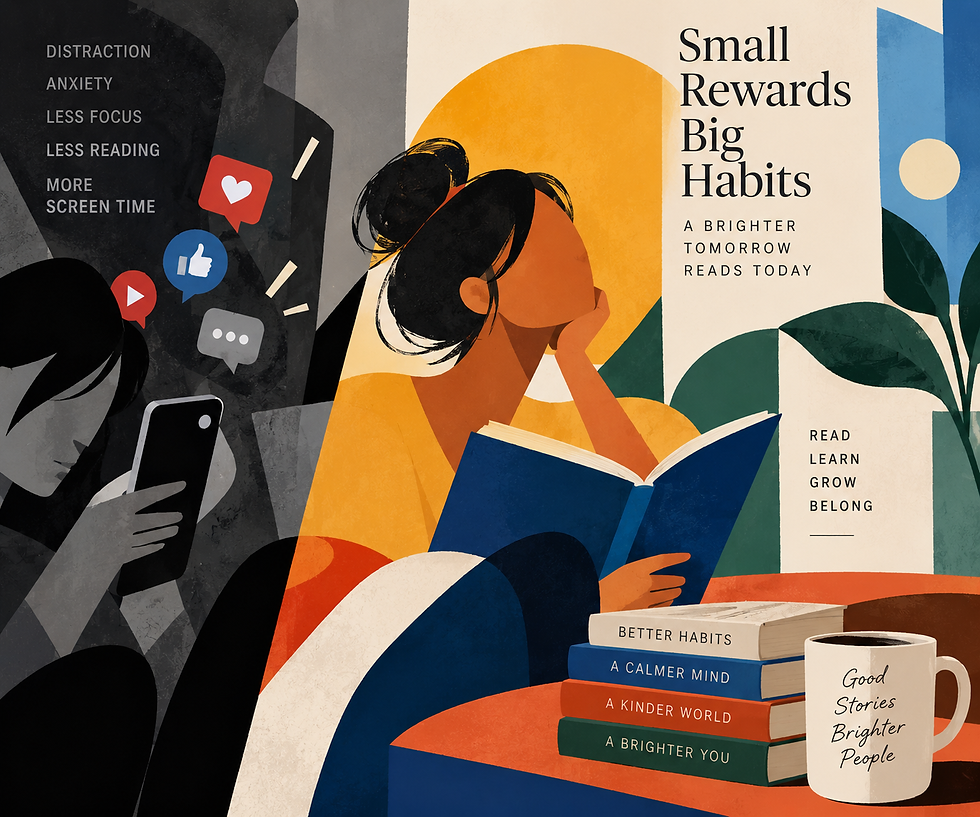
Could the answer to the growing reading crisis be as simple as paying people to put down their phones and pick up a book? Singapore appears willing to test the idea. In September 2026, the government launched a programme that rewards citizens with small cash incentives for recording their reading time on a government website.
The financial reward is deliberately modest. Participants must complete 50 reading sessions of at least 15 minutes each to earn one Singapore dollar, roughly £0.59, and only one session can be recorded each day. In other words, nobody is going to become rich by reading.
Yet behavioural scientists and psychologists believe the programme could still have an important effect—not because of the money itself, but because of the way small rewards can help establish habits.
Jonathan Haidt, psychologist and author of The Anxious Generation, argues that children are particularly responsive to rewards. While some are strongly motivated by money, he says that “all kids respond to rewards to some degree”. For young people, therefore, even a modest incentive could help initiate a regular reading habit.
Lory Barile, associate professor of economics at the University of Warwick, points to another important principle: repeated behaviour can gradually become automatic. The more consistently someone performs an activity, the more likely it is that the activity will eventually become part of their routine.
But there is a crucial question: what happens when the reward disappears?
If people discover that they genuinely enjoy reading, Haidt suggests, the habit may continue even after the financial incentive ends. Reading can then become its own reward. There is, however, a potential downside. For some people, the financial incentive may communicate that reading is something worth doing only because they are being paid for it. Once the payment disappears, so might the motivation. Barile therefore argues that the most important question is not whether people read more while they are being rewarded. The real test is whether the programme helps them establish a reading habit that survives after the rewards stop.
The power of a very small reward
The tiny size of Singapore's financial incentive may actually be part of what makes the experiment interesting. Ivo Vlaev, professor of behavioural psychology at the National University of Singapore, points out that incentives do not necessarily become more effective in direct proportion to their monetary value.
“Incentives do not always work in proportion to their monetary value.”
The programme should therefore not be viewed as a conventional transaction in which the government is effectively buying people's reading time. One Singapore dollar every several weeks is obviously nowhere near enough compensation for the time spent reading. Instead, Vlaev suggests, the payment may function more as a trigger than as a wage.
Participants log their reading, see their progress, maintain a streak and move towards a goal. These immediate signals provide recognition and a sense of progress—something that can be particularly powerful in an environment dominated by smartphones and social media, where people are accustomed to receiving instant feedback.
Once someone has started reading, the intrinsic rewards of the activity may begin to take over.
Can reading compete with the dopamine of scrolling?
One of the most interesting aspects of the Singapore programme is that it introduces an immediate reward for an activity whose benefits are generally long-term. Reading improves knowledge, vocabulary, concentration and imagination, but these benefits accumulate gradually. Scrolling through social media, by contrast, offers an almost continuous stream of immediate stimulation and feedback. The Singapore programme attempts to bridge that gap. Patrick Taylor, director of the Behavioural Insights Team—originally established within David Cameron's Cabinet Office and often referred to as the "nudge unit"—believes the gamification of the programme could be even more important than the money. A manageable 15-minute daily target, incorporated into an existing routine such as commuting or bedtime, can make reading feel achievable. Tracking progress and maintaining streaks can provide additional motivation.
In this sense, the programme is not simply paying people to read. It is attempting to make reading behaviour resemble some of the mechanisms that make digital platforms so compelling: short, achievable goals, visible progress, repetition and immediate feedback.
The programme may be particularly useful for reluctant readers
The approach could be especially valuable for people who already want to read but struggle to get started. Katy Milkman, a professor at the Wharton School of the University of Pennsylvania, suggests that people who are already intrinsically motivated to read may simply need a small additional push to act on that intention. Vlaev similarly argues that a tiny immediate reward can sometimes bridge the gap between intention and action.
This distinction is important. The programme does not necessarily need to transform someone who has absolutely no interest in books into an enthusiastic reader. Its greatest value may be in helping someone who repeatedly thinks, I should read tonight, but instead reaches for their phone.
Once the book is open and the first 15 minutes have passed, continuing may become easier.
Britain already uses non-financial incentives
The idea of rewarding reading is not entirely new.
In the UK, children have long been encouraged to read through non-monetary rewards. Primary schools have used certificates and recognition schemes, while the Reading Agency's Summer Reading Challenge offers children badges and certificates as they progress. In such programmes, the reward is not valuable because of its monetary worth. Instead, it provides recognition, achievement and visible evidence of progress. This raises an interesting possibility: perhaps governments do not need to pay people at all.
A future programme could compare different forms of motivation—small financial rewards, books, badges, certificates, competitions, streaks and progress tracking—to discover which mechanisms actually produce lasting reading habits.
A possible experiment
Barile suggests that a UK pilot could compare financial rewards with symbolic rewards, while also testing elements such as gamification, goal-setting and progress feedback. Haidt proposes an even more structured experiment.
One group of children could receive cash for reading. Another could receive free books of their choice, making the book itself the reward rather than money. A third group could earn points or participate in a competition without receiving any financial reward.
A fourth group would receive no intervention at all and would simply be observed as a control group. Such an experiment could answer a question that remains unresolved: which form of incentive creates the strongest and most durable reading habit? More importantly, researchers could determine whether people continue reading after the external reward has disappeared.
Should governments pay people to do something they are supposed to enjoy?
This is perhaps the philosophical question at the heart of the debate. Reading has traditionally been regarded as a leisure activity—something people do because they enjoy it. Paying people to read might therefore seem to undermine the very idea of reading for pleasure.
But Katy Milkman offers a different perspective.
Societies already subsidise many forms of education, and in some cases make education compulsory. If reading provides substantial educational and social benefits, there is an argument for encouraging it through public policy as well. The Singapore experiment therefore raises a broader question than simply whether people should be paid to read.
It asks whether, in an age when smartphones and social media are engineered to capture our attention through immediate rewards, traditional activities such as reading need new forms of encouragement to compete. Perhaps the money is not the point.
Perhaps the real objective is to get someone to put down the phone, open a book, read for 15 minutes—and then discover that they want to read for another 15.


Comments