Exploring Boundlessness: Alka Bhrushundi's
- ROMARTIKA CORRESPONDENT
- Mar 5
- 3 min read
Updated: Jun 6
On view 3 – 9 March 2026 | AC Gallery–1, Jehangir Art Gallery, Mumbai

In Athaha, Alka Bhrushundi presents a body of work that meditates on the idea of boundlessness. She does this not through spectacle or scale alone, but through an intimate visual language. This language situates infinity within the subtle rhythms of perception. The exhibition unfolds as a series of abstract explorations where cosmic imagination and organic form coexist. It invites viewers into a contemplative encounter with color, texture, and space.
The Dominant Chromatic Field
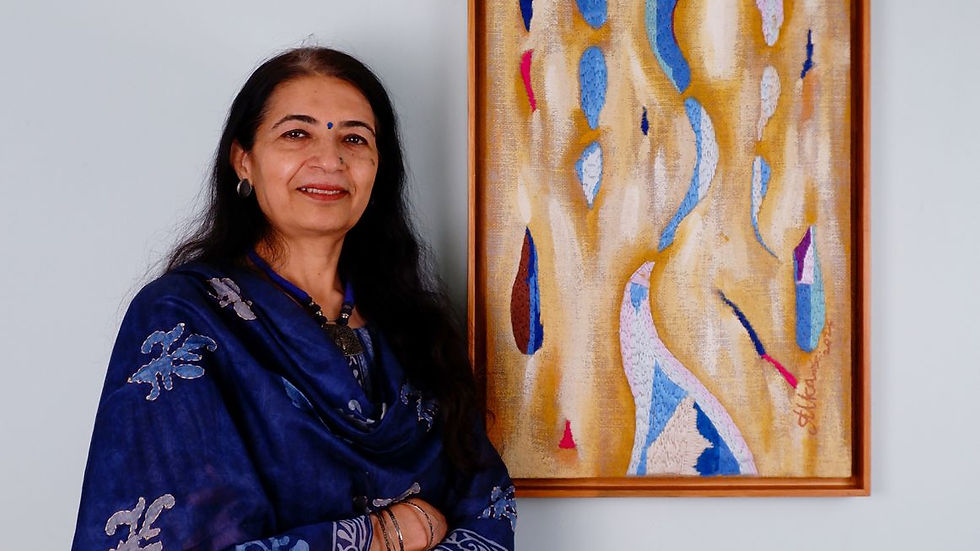
Bhrushundi’s compositions revolve around a dominant chromatic field of blue. This blue is far from static; it shifts between luminous azure, deep indigo, and translucent washes. These colors appear to breathe across the canvas. Against this fluid expanse emerge vibrant eruptions of rusted orange, muted gold, and smoky greys. These tonal shifts create an atmosphere that feels both aqueous and celestial. It is as though the viewer is suspended somewhere between oceanic depth and interstellar vastness.
Organic Structures and Visual Vocabulary

The artist’s visual vocabulary draws heavily from organic structures. In one painting, looping calligraphic lines coil and interlace across the center. This forms a network that recalls neural pathways, tangled roots, or microscopic cellular diagrams. The effect is not rigidly geometric but alive, pulsating with movement. These linear elements seem to map invisible flows of energy. They suggest a hidden architecture underlying both nature and consciousness.
Unexpected Elements
Floating within these vibrant fields are unexpected elements. Delicate white feathers, textured triangular forms, and luminous fragments resemble planetary shards or mineral formations. The feathers, in particular, introduce a striking counterpoint. They are symbols of weightlessness drifting across dense, turbulent surfaces. Their presence softens the intensity of the surrounding colors while simultaneously reinforcing the exhibition’s central tension between gravity and release.
Materiality and Tactility
Materiality also plays an important role in the works. The surfaces carry a layered tactility. Paint appears splashed, misted, and built up in patches. This allows colors to seep into one another. Certain sections glow with metallic accents, catching light in ways that evoke fissures of gold or glimmers within geological strata. These material shifts create an illusion of depth, pulling the viewer into an almost atmospheric interior space.
Bridging the Past and Present
What distinguishes Athaha is the way it bridges Bhrushundi’s earlier engagement with devotional imagery and her current move toward abstraction. Rather than depicting divine figures, the artist now seems to pursue the sensation of the sacred itself. This sensation is rendered as vibration, flux, and luminous stillness. Spirituality here becomes experiential rather than representational. It emerges through color relationships, spatial tension, and rhythmic pattern.
Perceptual Scales
The paintings operate simultaneously on two perceptual scales. From a distance, they resemble cosmic landscapes. Galactic vortices and stellar clouds form across expansive skies. Up close, however, the imagery shifts toward the microscopic. Cellular membranes, flowing currents, and fragile biological structures come into focus. This oscillation between macrocosm and microcosm becomes central to the exhibition’s philosophical undertone. It suggests that infinity might be encountered not only in the vastness of the universe but also within the smallest units of life.
A Slower Mode of Looking
In an era saturated with rapid imagery and fleeting attention, Athaha insists on a slower mode of looking. The works resist immediate interpretation. Instead, they reward prolonged viewing, gradually revealing subtle transitions of color, texture, and movement. Over time, the viewer begins to sense a meditative rhythm in the paintings. This quiet pulse echoes the exhibition’s title, which evokes immeasurable depth and endlessness.
Cultivating Awareness of Infinity
Ultimately, Bhrushundi’s exhibition is less about illustrating infinity than about cultivating an awareness of it. Through layered abstraction and organic symbolism, the artist transforms the canvas into a field of contemplation. Here, the boundaries between inner consciousness and outer cosmos begin to dissolve. Standing before these works, one is reminded that infinity may not lie somewhere beyond us. It may already reside within the delicate, shifting landscapes of our own perception.
Analysis of one of the signature paintings by the artist, done by the AUTOCURATOR TOOL of Romartika can be downloaded for deeper exploration.


Comments