Ink, Silence and the Art of Staying
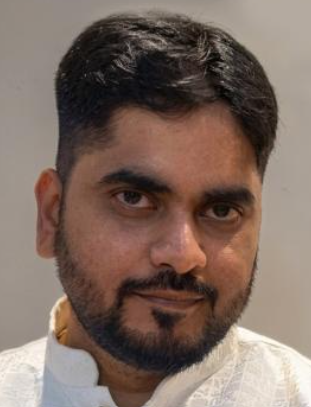
Shrikant T Vishwakarma on the meditative practice of Nehal Rathod

The most rigorous artistic practices are rarely the most visible. They are built through sustained commitment to a single question, pursued until that question becomes legible in the work itself. Nehal Rathod, Mumbai-based visual artist works precisely here. Her practice is one of deliberate accumulation. Each mark an act of inquiry, each composition a record of time made tangible.
Nehal arrived at visual art not through conventional formation but through an extended engagement with teaching, travel, and introspection. Born in Mumbai, she developed an early attentiveness to the interconnections between place, memory, and human experience. After completing a Bachelor of Engineering in Computers in 2009, she chose to teach electronics, microprocessors, and mathematics to engineering students for nearly eight years. Most people would not draw a line between teaching microprocessors and making art. But the patience that teaching demands, its insistence on showing up and refining understanding day after day, left its mark. That period reads not as a detour from her artistic identity but as its quiet rehearsal.
In 2017, motherhood brought with it a period of necessary stillness. It was here that her reconnection with nature and literature, the very currents that now run through her work, quietly resumed. In 2023, she began formal study under Russian-Italian artist Anastasiia Morozova. By 2024, Nehal Art Studio had been established as the platform through which her work began reaching its audience.

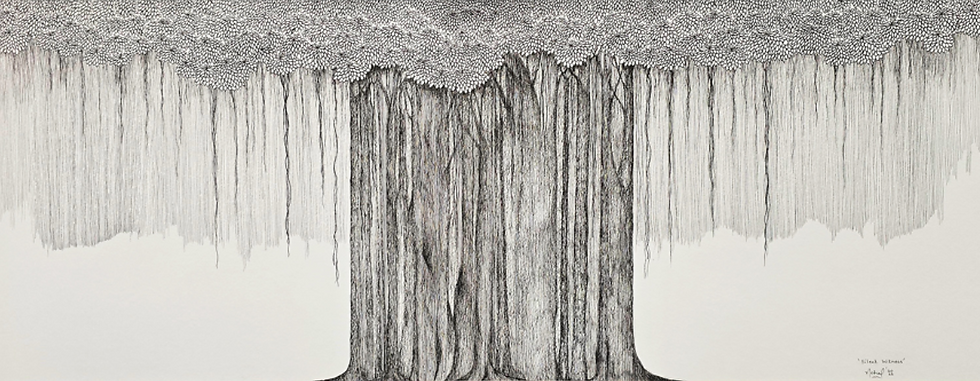
Nehal works in India ink and watercolor on cotton paper. Her compositions sit at a threshold between the figurative and the abstract, between image and impression. She describes this quality as intentionally open-ended, a refusal to dictate meaning in favour of enabling encounter. The viewer is not steered toward a predetermined response, they are offered a space in which their own inner experience may surface. That is harder to achieve than it sounds.
Agnes Martin, whose grid paintings similarly refused narrative closure, wrote that her work had nothing to do with what anyone could see, only with what one felt. Something of that same conviction runs through Nehal's practice. Her compositions do not describe, they disclose. The stippled surfaces and fine, repetitive linework accumulate into fields of visual and emotional density that resist rapid reading. Form earns itself through sustained attention. The artist's first, the viewer's second.

Her subjects are drawn consistently from the natural world. The concentric geometry of aged wood, the aerial formations of starlings, the organic patterning inherent in growth and cyclical movement. These are not merely visual sources. They are the philosophical grounding of the practice itself. Nature, for Nehal, is the primary teacher of patience; of the intelligence that reveals itself only through unhurried observation. The same structures recur across her body of work not because invention has been exhausted but because the inquiry has not yet been completed. Repetition, here, is a method of knowing.
What distinguishes Nehal's position in contemporary Indian art is her commitment to slowness, not as stylistic preference but as philosophical stance. In a cultural landscape that privileges immediacy and spectacle, choosing to build a work dot by dot, hour by hour, is a genuinely countercultural act. Each artwork is born, in her own words, through experimental and intuitive exploration until it embodies the precise emotion and narrative she aims to convey. The process does not conclude when an image is formed, it concludes when the work achieves internal necessity.

Simone Weil wrote that attention is the rarest and purest form of generosity. In Nehal's practice, this generosity operates in both directions. She extends it through the discipline of her making, the work demands it in return. The monochrome works, built from thousands of careful dots and intuitive brush lines, achieve a density that is meditative and exacting in equal measure. The calming washes breathe rather than declare. Presence accumulates, it is not asserted. Her works do not illustrate the natural world, they disclose its interior logic. The patience of growth, the discipline of repetition, the meaning that surfaces only when perception slows sufficiently to meet it.
Nehal's intention is to evoke memory in those who encounter her work and to foster a reconnection with the self and with the surrounding world. Each piece is an invitation extended without insistence. It does not demand to be understood immediately. It simply waits.
For collectors and curators attentive to process-driven contemporary Indian art, her work is worth serious attention. It does not offer quick legibility. What it offers instead is rarer: the evidence of an artist who has chosen to make the time required for genuine making, and to render that time visible in the work itself.




Comments